銀座公式ウェブサイト


Explore Ginza
Announcements ・ Updates
More about Ginza
Visit Architecture
Visiting Ginza’s Architecture Vol.6 Ginza District Heritage
2026.02.01
This time, we will take a slightly different approach and explore the traces of history remaining in Ginza's streets around the theme of “Ginza District Heritage.” Ginza is such a vibrantly active district that it is extremely difficult to find old buildings or relics that tell its history. We took a stroll with the perspective of seeking out anything that might tell the story of this area's development.
- Uino
- Ogikubo-san, do you remember this book?
- Ogikubo
- You mean “A Tale of Ginza’s Willows” by Mr. Katsumata, who founded “Noble Pearl” in Ginza 8-chome. I referenced it extensively during our previous series “Exploring Ginza’s Inari Shrines.”
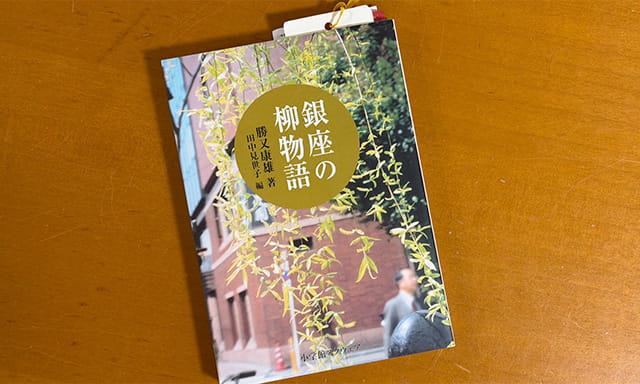
”A Tale of Ginza Willows.” It tells not only the story of the willow but also the history of Ginza. - Uino
- Mr. Katsumata worked tirelessly to restore the willow trees of Ginza. He was a master of Ginza who cared deeply for the town. According to this book, Ginza used to have several wells, so historically, it was a water source. Ginza is close to the sea, and yet it had freshwater wells.
- Ogikubo
- There are stories that Edo’s well water was undrinkable because it contained seawater due to its proximity to the ocean. However, Ginza was part of what was called Edo-mae Island, a peninsula-like stretch of land, since early times, so it likely had access to fresh water.
- Uno
- So I tried tracing the information about old wells mentioned in the book. Although it was quite a while ago, I had a vague memory of seeing something resembling a well near the Tenkuni Building in Ginza 8-chome…
- Ogikubo
- Did you find anything?
- Uino
- Unfortunately, I couldn’t find anything. I also once heard that the Recruit 8-chome Building, where the Creation Gallery used to be, used spring water to water the plants around the entrance. But that building is no longer there either, as it was demolished for redevelopment.
- Ogikubo
- Sorry to hear that!
- Uino
- But according to someone from the Neighborhood Association of Ginza 4-chome, where Hōdō Inari Shrine is located, there used to be a well called ‘Kitamura Tōkoku’s Well’ on Namiki-dōri. It was right around where the Seiko Museum stands now.
- Ogikubo
- Kitamura Tōkoku is a literary figure from the Meiji era, right? I believe he lived in Ginza’s Yazaemon-cho as a child. If it was located where the Seiko Museum is now, Hodo Inari Shrine would be right behind. If only some trace of it remained, even if the well itself no longer exists.
- Uino
- Isn’t it fascinating to think that deep beneath the streets of Ginza, there are water veins?
- Ogikubo
- Even now, if you were to dig down, water would probably come up, but I doubt it would be safe to drink. Speaking of traces of history around here, we have the gas lamps. The information boards explaining them are placed so close to the ground that most people don’t even notice them.
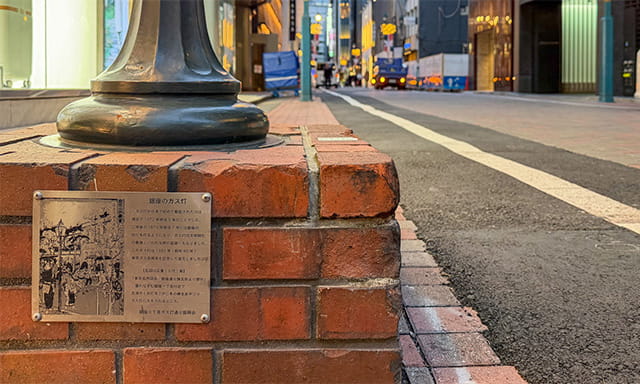
Four gas lamps have been restored on Gas Lamp Street.
>Many people miss the information panels at the base of the gas lamps.- Uino
- Oh yes, there are four restored gas lamps. You have to look closely to notice, but they are indeed lit by real gas. You can clearly see the flame flickering.
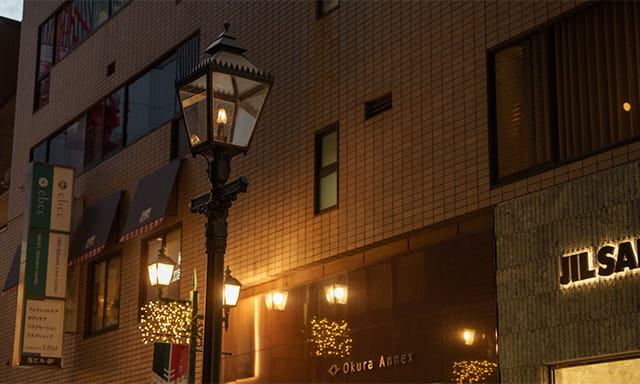
Compared to electric lights, the light is dimmer, but the flicker and warmth are signature of a gas lamp - Ogikubo
- It is said that gas lamps first lit the streets of Ginza in 1874 (Meiji 7). While Japan’s first gas lamps were installed in Yokohama, Ginza was the first area in Tokyo to have them. I believe these are the first lamps, drawn in this Meiji-era “nishiki-e” print.。
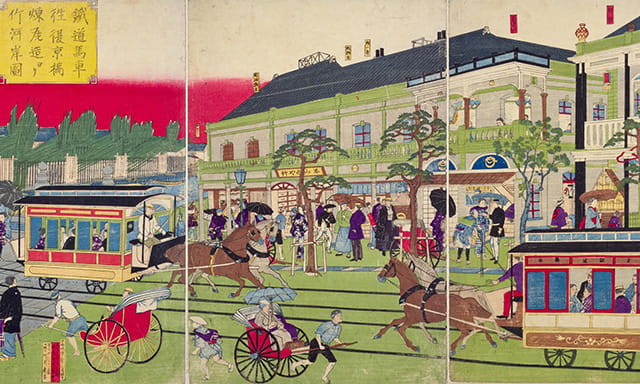
”Horse-Drawn Railway Carriage Round Trip: View from Kyobashi Brick Bridge to Takegashi”
(National Diet Library Digital Collection), published in 1882 (Meiji 15).「
A gas lamp is drawn near the center.- Uino
- It was the moment artificial light pushed back the darkness of night.
- Ogikubo
- A symbol of the Meiji Restoration. It’s no exaggeration to say city night life began here. Gas lamps would later be replaced by electric lights. Actually, there’s a plaque here marking where Ginza’s first arc lamps were lit.
- 宇井野
- The moment artificial light pushed back the darkness of night.
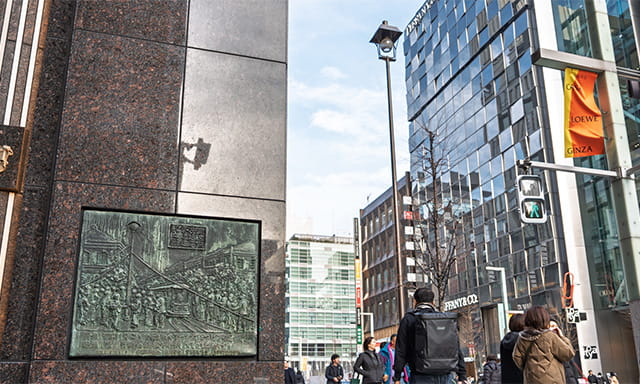
The plaque “Tokyo Ginza Street Electric Light Construction Diagram”
Replica arc lamps line the street.- Uino
- This is the Ginza 2-chome intersection, isn’t it? Why are we here?
- Ogikubo
- In fact, this plaque is mounted on the wall of Okura Main Building. In 1882, Kihachiro Okura wanted to showcase electric light, so he installed Japan’s first arc lamp in front of the Okura Group Trading Company.
- Uino
- So Ginza was also where electric light first illuminated the city streets.<
- Ogikubo
- A replica stands in front of the Okura Main Building, so it is a must-see for anyone visiting Ginza at night.
- Uino
- Ginza was also where new infrastructure was first installed. Now that we have covered water, gas, and electricity, shall we explore more traces of Ginza’s infrastructure history?
- Ogikubo
- Let us head towards Shimbashi. Shimbashi was the entrance to Ginza when people came from outside. For a time during the Edo period, a magnificent gate stood just beyond the Shimbashi bridge.
- Uino
- It’s marked as the site of the Shibaguchi Gate.
- Ogikubo
- For just 14 years, from 1710 to 1724, the Shibaguchi Gate stood here. When you look at maps of Edo from that time, you will see that Shimbashi labeled as Shibaguchi Bridge. The Shiodome River, now reclaimed and occuppied by the Metropolitan Expressway above and commercial facilities below, once flowed through this area. The gate to the Edo Palace was constructed across that river.
- Uno
- The gate indicates that Ginza must have marked a boundary between the “inside and outside”.
- Ogikubo
- It seems the gate was built because Edo still lacked a western gate (and thus needed one) when receiving the Korean Envoys, so it’s plausible that the Shiodome River served as the boundary.
- Uino
- This was the southwest boundary of Ginza. The southeast boundary was the Sanjikken-bori moat, right?
- Ogikubo
- That’s right. Now completely reclaimed, the Sanjikken-bori site has become a road, and even the area outside the moat is now has a Ginza address, so people hardly notice anymore. But roughly around here, the Sanjikken-bori joined the Shiodome River… Oh.
- Uino
- Is anything wrong?
- Ogikubo
- I just discovered the site of the Sanjikken-bori moat. The stone embankment used for the moat is casually preserved as a historic site beside the Metropolitan Expressway. I never noticed this before.
- Uino
- It lets us remember that there used to be a waterway here.
- Ogikubo
- Back when Edo was founded, the area beyond here was shallow sea. To bring in supplies by large ships, they dug a deep and wide waterway – thirty-ken (around 54.5 meter) wide and reinforced it with stone walls.
- Uino
- The Sanjikken-bori moat also appeared many times during our series covering Inari Shrines. This wide moat carried goods flowing through here. Ginza was a city of logistics, as well as a waterside town. The well we saw earlier was a single “point” of water; the Sanjikken-bori moat was a “line.”
- Ogikubo
- You can see it was a logistics hub: the Tōkaidō road, the land route, ran through the center of Ginza, and the Sanjikken-bori moat, the water route, ran to the east.
- Uino
- It’s fascinating to think everything was interconnected by water.
- Ogikubo
- Actually, nearby you can still find remnants of this logistics network connecting land and water routes. Let’s walk a bit further east along the Metropolitan Expressway… or rather, along the former Shiodome River.
- Uino
- Is this a railroad crossing? For trains?
- Ogikubo
- That’s right. When the current Shiosite was Shiodome Freight Station, a freight line connecting Tsukiji Central Wholesale Market and Shiodome ran here. Now only the railroad crossing signal remains, and the former tracks have become a road.
- Uino
- Did you know about this traffic signal, Ogikubo0-san?
- Ogikubo
- Actually, the editorial offices of ASAHI PC Magazine and ASAHI Camera Magazine, which I used to work with, were in the Asahi Shimbun building. So, I often used this road to get there for meetings and roundtable discussions. Back then, I wondered why there was a railroad track here, but it makes sense now that it was a spur line to the Tsukiji market.
- Uino
- The Tsukiji market has also relocated, and now only the road and traffic light remain, but it is important that memories of this place is preserved in this way. I believe the heritage of the Ginza area lies not only in its buildings, but in the very infrastructure that has supported the city.
- Ogikubo
- I recommend occasionally strolling like this, searching for remnants of history, and reflecting on how present-day Ginza stands upon layers of the past.
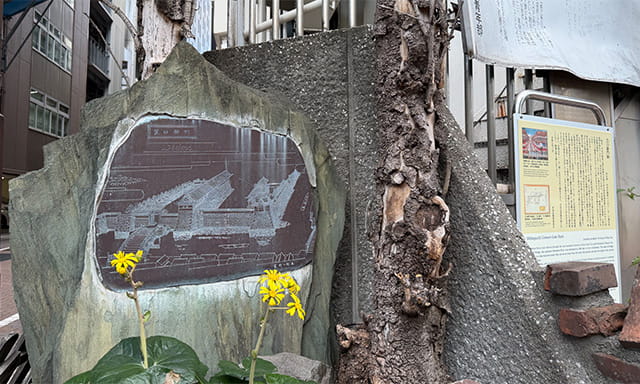
Stone monument at the site of the Shibaguchi Gate. 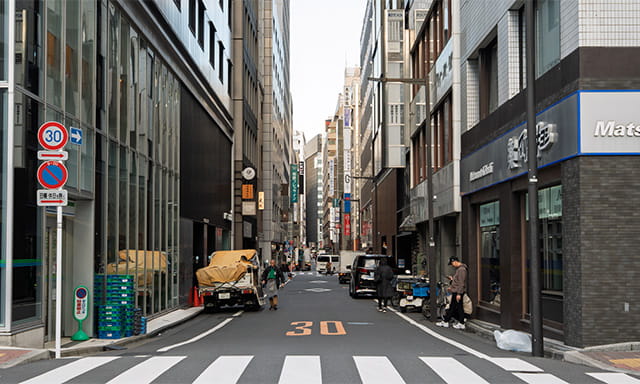
The site of the Sanjikken-bori is now just an ordinary road. 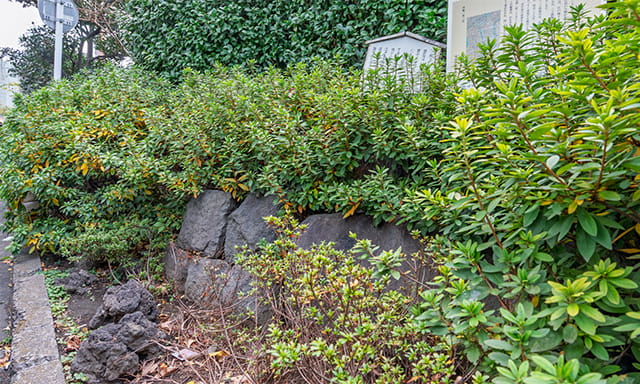
The stones used for the Sanjikken-bori canal’s embankment have been preserved, with an accompanying information panel. 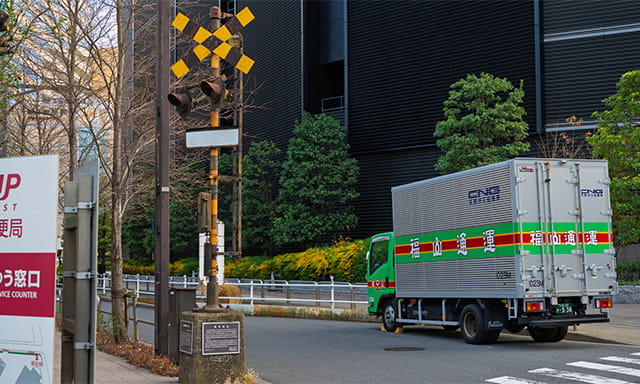
The only remaining railroad crossing in Ginza.
The tracks that once carried goods by train is now a road for trucks.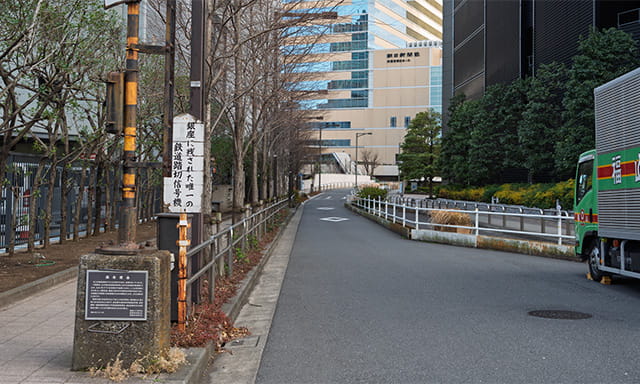
The gently curving road follows the former railroad tracks.
It once led straight to the Tsukiji Wholesale Market.During our stroll, Ogikubo-san seemed intrigued by various manhole covers for water, gas, sewage, communications. “You can tell when they were installed from the patterns and letters engraved.” he remarked. Undiscovered relics of daily life may still be close at hand. We look forward to your exciting discoveries too.
All List
- 2024.11.05 Exploring Ginza’s Architecture Vol. 1 Kyobunkwan-Seishokwan Building
- 2025.02.01 Exploring Ginza’s Architecture Vol. 2 Ginza’s Police Boxes
- 2025.05.15 Exploring Ginza’s Architecture Vol. 3. Marunouchi TOEI
- 2025.08.01 Exploring Ginza’s Architecture Vol. 4 Daiichi Sugawara Building
- 2025.11.01 Exploring Ginza’s Architecture Vol.5 Ginza Church
- 2026.02.01 Visiting Ginza’s Architecture Vol.6 Ginza District Heritage